Introduction
Insurance can either be at-fault or no-fault. It has an influence on how you manage the aftermath of an automobile accident.
What makes a difference? All drivers are required by the no-fault law to have personal injury protection coverage. This makes it simple for drivers to obtain health insurance in the event that they are hurt in an automobile accident.
No-fault accident regulations are hotly debated. This is primarily because most drivers are already covered by health insurance. It makes them unnecessary & costly.
You must be curious about the specifics & whether your insurance will increase if you have been involved in a no-fault collision.
No-Fault Accident
When an accident happens in most states, someone is held accountable.
In the majority of incidents, one driver is obviously at fault unless two cars both disobey stop signs & collide or enter into the middle line from opposing directions and wreck. That isn’t always the case in a no-fault state.
The driver only needs to submit a claim for compensation when they are hurt in an automobile accident in a no-fault state. The claim must be paid by the other driver’s insurance company after it is filed.
Whether the wounded driver was the cause of the collision or the victim is irrelevant. They don’t need to prove who triggered the accident to be eligible to apply for coverage.
Although this guarantees payment of the claim, there is a catch. The person who was hurt cannot file a lawsuit for further damages.
Is California No-Fault?
California isn’t a no-fault state.
Even though an injured motorist can still make an appeal to the other driver’s insurance and have it compensated, it doesn’t stop there. According to California auto accident lawyers, drivers in California are still able to file a lawsuit for further damages.
Insurance: No-Fault versus At-Fault
Pursuant to the Insurance Information Institute, the goal of the no-fault system is to lower the cost of motor insurance by removing minor claims from the legal system. Regardless of who caused the accident, each insurance provider pays its insured for minor injuries under this type of coverage.
In order to make this process simpler for innocent victims, many states have updated their laws. This often relieves the victim, who wasn’t at fault in the collision, of the burden of proving the other motorist was at fault before they can be compensated. The no-fault insurance coverage refers to this as personal injury cover.
People often search whether California is a no-fault state for car accidents.
In an at-fault jurisdiction such as California, the insurance companies compensate for the damages incurred depending on the degree to which each party is at fault. In the event that the person is injured, the driver who caused the accident is liable for the injuries. The injured victim will be paid by their own insurance company. In case the insured individual disputes the amount paid to them, they can initiate a lawsuit & seek to receive non-compensated damages.
To present your case and prove that you deserve the money that you are entitled to, it is important to work with a competent auto accident lawyer.
We are both at fault: What happens?
The regulations of fault are applied differently by at-fault states. “Pure comparative blame” is the precise legal term used in California. Knowing this is important since these regulations may limit your recovery.
Both drivers are often somewhat to blame for the collision. Your compensation is lowered according to pure comparative fault legislation based on your level of involvement in the accident. They are displayed as percentages.
For instance, you would only get $70,000 if you were given $100,000 and found to be 30% at fault. California personal injury attorneys have to put up a strong battle on behalf of their clients to demonstrate that their fault was negligible or nonexistent. Many accident victims look into whether California is a no-fault state for car accidents.
How Can I Minimize Fault?
Being a safe driver is the easiest way to lower your degree of fault. In the event of an accident, it is much more probable that the other motorist would bear more of the blame if you follow the traffic laws and avoid taking risks.
Speaking with a personal injury lawyer as soon as feasible after your accident is another strategy to lessen fault. To avoid exposing yourself to liability, a lawyer can advise you on what to disclose, along with what not to mention to insurance firms or the opposing party.
Comprehending the Motivations of Insurance Companies in Fault-Based Insurance States Such as California
The insurance company is encouraged to assign a percentage of fault to an injury victim with significant damages to reduce the amount they must pay on a claim, even though California’s pure comparative negligence rules protect a driver who partially caused an accident. This safeguards their earnings at the price of a person who was hurt but wasn’t actually at fault for the collision.
It might be difficult to present a strong case for full compensation without an attorney to conduct an investigation. Gather concrete proof of the at-fault driver’s guilt, and present the results to the insurance company. The matter may go to court for a jury verdict if, after discussing with the person who was injured and their lawyer, the insurance company is unable to provide a satisfactory settlement. Few cases need to go to court in California since the state’s fault-based vehicle accident regulations resolve about 95% of claims through settlements.
According to California’s statute of limitations, the injured victim has to submit a lawsuit petition no later than two years after the day of the vehicle accident if the accident claim proceeds to court.
How Does a California Auto Accident Affect My Insurance?
When it comes to reevaluating a policyholder’s driving record, different insurers have different policies. An insurer typically raises the premium by a set percentage when a policyholder submits an insurance claim after an at-fault collision that exceeds a particular level.
The rate of rise may be influenced by the seriousness of an accident and the ensuing cost of insurance premiums. The premium rise for a minor driveway collision is not as high as that of a catastrophic accident.
Your automobile accident or traffic infraction may be deleted from your record by the Department of Motor Vehicles (DMV) after a few years. As a result, the cost of a typical auto insurance policy can be reduced.
Generally speaking, insurers only raise premiums when you are involved in an automobile accident that causes property damage or injury to other people.
There are some exceptions.
- Your car got damaged in a hit-and-run incident.
- You had lawfully parked your car during the collision.
- You did not receive a moving traffic infraction even though another driver hit your car from behind.
A key topic in auto law is whether California is a no-fault state for car accidents & how fault is determined.
California Car Accident Fault Determination
It is simpler to prove your argument & hold the responsible party accountable when you can establish culpability in an accident. One or more drivers at least did not obey the rules of the road and behaved carelessly. Some of the examples of risky behavior include drunk driving, driving too fast, darting in and out of normal traffic, & tailgating.
The evidence that follows can be used by an insurer or lawyer to prove fault:
- Statements from witnesses
- Health records
- Images from the scene of the accident
- Report on a police accident
- Reconstruction of an accident
- Surveillance camera footage
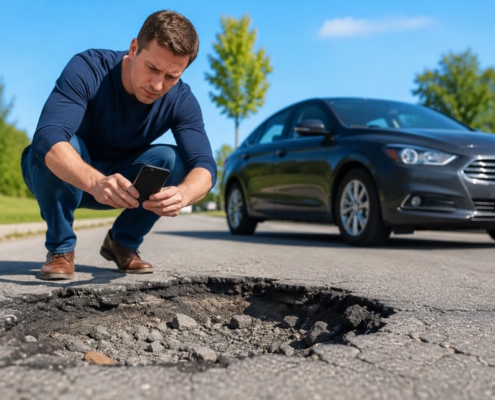
Major car accident injuries can sometimes render a driver incapable of protecting themselves. However, if an injured person is able to use a mobile device safely, they can start recording evidence at the scene of the accident that will help them later on in the accident claim procedure pursuant to the fault-based auto accident laws.
Car Insurance: Minimum Requirements
Drivers have to keep insurance in the majority of states. The list includes California. If you are at fault for an accident, the minimum coverage requirement offers financial protection.
Getting more insurance than the state’s minimum is in the driver’s best interest. If you are at fault for an accident, the person who was hurt may sue you to get more money than your insurance will pay.
With the goal of safeguarding the asset you are likely to lose in a lawsuit, you need to purchase an insurance policy with adequate coverage.
The California Insurance Code 11580.1 specifies minimal insurance requirements.
- $15,000 for one person’s harm or death
- $30,000 for many people’s harm or death
- $5,000 for damaged property
If you get liability insurance, the coverage pays third parties for property damage or personal injury.
In California, the following kinds of insurance are acceptable:
- $35,000 in cash deposited with the DMV
- A policy for auto liability insurance
- $35,000 surety bond obtained from a California business license
- A self-insurance certificate from the DMV
Contact an Attorney
You must be clear whether California is a no-fault state for car accidents before taking legal action.
You can file a lawsuit if you are in a no-fault collision. You ought to believe it was caused by the other motorist. California isn’t a no-fault state.
You need expert assistance to manage intricate insurance regulations and driving restrictions. Regardless of culpability or no-fault rules, we always advise drivers to drive very carefully. An experienced car accident lawyer in California can assist you in obtaining damages for things like the following if you have already been in an accident or suffered injuries as a result of one:
- Insurance bills
- Lost income
- Suffering and agony
- Transportation expenses
- Rehabilitation