Function of the Parietal Lobe in the Brain
The parietal lobe supports sensory input, spatial awareness, movement coordination, language, and attention. Parietal lobe damage can affect sensation, movement, recognition, body awareness, and recovery.

The parietal lobe supports sensory input, spatial awareness, movement coordination, language, and attention. Parietal lobe damage can affect sensation, movement, recognition, body awareness, and recovery.

By Brad Nakase, Attorney
Email | Call (888) 600-8654
Have a quick question? I answered nearly 1500 FAQs.
The number of synapses in a single brain would be far greater than if you were to look into the immense depths of the Milky Way & count each star individually. In actuality, the number of synapses in our cerebral cortex would require more than 1,500 Milky Way galaxies. Our cerebral cortex is thought to contain over 125 trillion synapses. Because of this, even the most sophisticated supercomputers cannot equal the speed at which our brain can compute data.
Receiving and interpreting information is our brain’s most vital function out of all its many duties. We will talk about the parietal lobe & how it helps us function.
The most important function of the parietal lobe is sensory perception & integration. Touch, sound, taste, and the other five major senses can all fall under this category. The brain’s primary sensory region is located in the parietal lobe. Any signals from the hands, eyes, ears, and other parts of the body must be interpreted by this region. Research has demonstrated that the parietal lobe uses more surface area when it receives more sensory information at once. Like the majority of the brain, the parietal lobe is still poorly understood, but it is recognized to perform certain tasks.
Other key roles of the parietal lobe include:
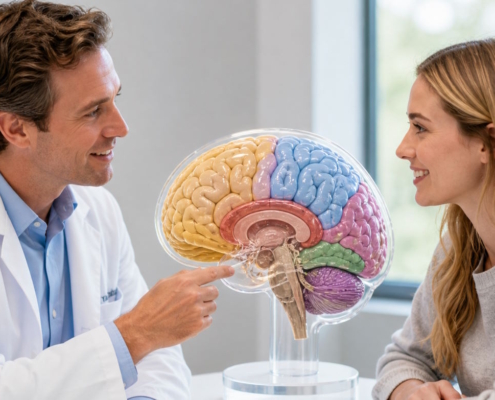
A common biology topic is what the parietal lobe controls in the human brain. The brain’s four lobes are composed of distinct structures that support healthy brain function. Together, these structures form the parietal lobe, each of which serves a distinct purpose in the brain. Among these structures are:
Must Read: What are the Main Functions of the Frontal Lobe of the Brain?
The brain does not have complete control over any one area on its own. Rather, each brain area and lobe collaborates with the remainder of the body to carry out its functions. This also applies to the parietal area. The parietal lobe needs input from every part of the body since it processes a lot of sensory information. The hands, eyes, hearing, and more are examples of these input regions. The parietal lobe and bodily components depend on each other for proper operation.
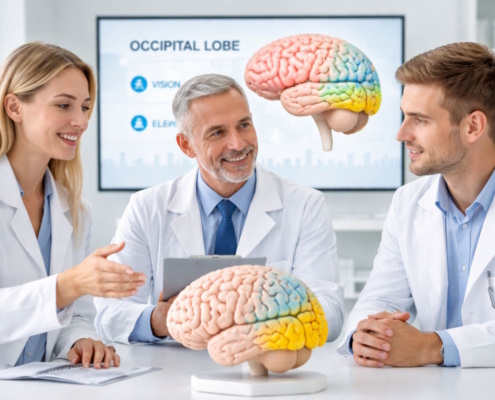
The parietal lobe interacts with the other brain lobes along with your body. The brain exchanges signals between the occipital & parietal lobes. The occipital lobe is important because it works with the parietal lobe to support visual processing.
Certain signals travel between the many brain regions, despite the fact that each one regulates a distinct set of operations. It has even been discovered that when one area of the brain is damaged, the other areas will make up for the missing functions. Brain injury patients sometimes learn what the parietal lobe controls during rehabilitation.
Damage to the parietal lobe can have a variety of effects due to its wide range of functions. The area of the parietal lobe that was most impacted usually determines the extent of the injury. It also relies on the severity of the damage and the course of treatment. Doctors may explain what the parietal lobe controls when discussing brain injuries.
Numbness on the other side of the body results from a deficiency in the front portion of the parietal lobes. Larger lesions may cause apraxia and right-left direction awareness in affected individuals. One side of the human body, across the brain lesion, may become paralyzed, and the person may disregard or even reject the occurrence of paralysis as a result of their diminished capacity to identify body parts or the space. Parietal lobe impairment is linked to hemispheral neglect, Gerstmann’s syndrome, & Balint’s syndrome.
Getting back as much function as possible requires proper medical care. Comprehensive speech & physical care, as well as treatment, may be included. You may teach your brain to function in lieu of the injuries you sustained with the right care. Your age, diet, health, and way of life are additional external factors that could hinder your recovery.
Have a quick question? We answered nearly 2000 FAQs.
See all blogs: Business | Corporate | Employment Law
Most recent blogs:


















Contact our attorney.