Introduction
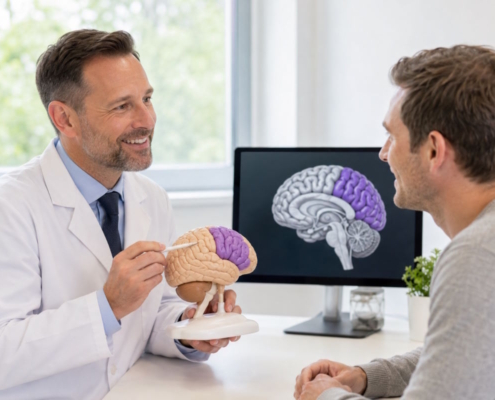
The frontal lobe is the brain’s critical element. They affect thinking, personality, judgment, emotions, self-control, memory storage, muscle control and movement, and more. It is your brain’s forward-most region, as its name suggests. The frontal lobe is a key area of interest for the medical field.
Frontal lobe: What’s it?
There are five lobes in your head. It includes the frontal lobe. You have a variety of skills because this part of your brain collaborates with numerous other brain regions. Primary functions of the frontal lobe are essential to everything you accomplish that requires conscious thought or action.
Primary functions of the frontal lobe
Your frontal lobe is responsible for numerous functions.
- Reasoning: Both basic and sophisticated information processing fall under the category of reasoning. This includes reasoning, logic, judgment, decision-making, & creativity.
- Social awareness: Your frontal lobe regulates your comprehension of social standards. It aids in deciding what is appropriate.
- Executive functions: Working memory, attention span, self-control, & inhibitions.
- Voluntary muscular movements: These are deliberate motions. Moving the legs to get up and move. Your hand for picking something up. It is responsible for controlling the muscles that you use to talk.
- Information processing & recall: It is the ability of your brain to absorb new information and store it for subsequent access. Later information retrieval is also aided by the frontal lobe.
- Managing attention, particularly selective attention: Disorders like attention deficit hyperactivity disorder (ADHD) can arise when the frontal lobe is unable to control attention.
Anatomy
1. Location of the frontal lobe
It is located at the front of the head. It is the area of your brain located directly behind your forehead.
The frontal lobe rests on the orbital layer of the frontal bone and is mostly located in the anterior cerebral fossa of the skull. It takes up one-third of the entire cerebral hemisphere and extends posteriorly from the frontal pole, which is its most anterior portion, to the middle sulcus, which divides it from the side of the parietal lobe.
2. Size of the frontal lobe
The frontal lobe includes twenty-five percent to forty percent of the cerebral cortex in your brain. (The projected range is larger since different researchers used different methods to establish the borders because your brain lacks distinct boundaries between sections.) “Tree bark” is what the Latin term “cortex” signifies. The surface of the brain that has wrinkles is called the cortex.
3. Frontal lobe constituents
The same specific cells that are located throughout your brain make up your frontal lobe.
- Neurons: The cells in the brain & nerves are capable of sending or relaying messages to other neurons. The signals are transmitted as electrical “impulses.” Electrical signals are transformed by your neurons into chemicals that get released from the cell. After detecting the substances, the subsequent neuron sends out a new impulse. A message moves swiftly both across and within neurons in this manner.
- Glial Cells: These cells support the neurological system. They don’t control signals. Rather, by removing waste, supplying nutrients, and providing structural support, they preserve the neurons.
Related: Brain Limbic Lobe: Where is it and what does it do?
Ailments and Disorders
Disorders and illnesses impacting the frontal lobe
Primary functions of the frontal lobe involve personality, planning, & emotional regulation.
Your frontal lobe can be impacted by a disorder that affects brain tissue. There are certain neurodevelopmental (related to brain development) disorders that particularly affect & cause symptoms in the frontal lobe. Your frontal lobe may be affected by the following illnesses and symptoms:
- Alzheimer’s disease.
- ADHD
- Expressive aphasia (it impairs speech patterns but not speech content)
- Autism spectrum disorder.
- Brain tumors (includes cancer).
- Brain lesions (from illnesses or injuries sustained during surgery or medical treatments).
- Poisoning by carbon monoxide.
- Corticobasal degeneration.
- Concussions and additional serious brain injuries.
- Genetic disorders.
- Frontotemporal dementia.
- Migraines, headaches.
- Infections (for example, those associated with encephalitis).
- Toxicity of heavy metals & other materials.
- Lewy body dementia.
- Seizures
- Psychiatric disorders
- TIA & stroke.
Symptoms that are typical of frontal lobe disorders
Conditions affecting the frontal lobe can manifest in dozens. These symptoms can differ greatly for a pair of factors:
- Numerous functions are controlled by your frontal lobe.
- There are many disorders that might impact your temporal lobe.
Although your frontal lobe might be affected by a wide range of symptoms, some symptoms are particularly prevalent. These comprise:
- Changes in personality.
- Difficulty planning, organizing, paying attention, reasoning, or dividing your focus between two projects.
- Executive impairment.
- Difficulty restraining your urges, including your actions and words.
- Specific types of memory loss, or amnesia.
- Difficulty using some muscles. For example, those used for speaking.
Injury to the frontal lobe often has a variety of consequences. Individuals with frontal lobe injuries may be aware of how to react in certain circumstances, but in real life, they may react inappropriately. In the same way, feelings could not show up on the face or in the speech. For instance, a joyful person would not grin, and their speech would be emotionless.
In the same vein, however, the individual could potentially demonstrate excessive and unjustified emotions. Stroke sufferers often suffer from depression. A decline or loss of motivation is also typical. Someone may not be “up to it” and not desire to engage in everyday tasks.
Tests that are commonly employed to assess the condition of the frontal lobe
The frontal lobe can be examined by medical professionals in a variety of ways. Diagnostic tests, laboratory testing, imaging scans, & more are among them.
- Blood testing can identify a variety of issues (immune system disorders, poisons, and toxins)
- CT (Computed tomography) scan.
- Electromyogram.
- Electroencephalogram
- Neuropsychological testing.
- Evoked potentials
- Positron emission tomography scan
- Magnetic resonance imaging
Management of frontal lobe damage
A physician will treat both the underlying cause and the symptoms of frontal lobe injury.
A physician could:
- Give a prescription to treat an infection.
- Perform surgery to eliminate a growth
- Administer medication to break up a blood clot.
- Suggest eating a different diet.
- Suggest exercising to lower the chance of having another stroke.
- If someone has dementia, create a long-term care treatment plan.
- Recommend rehabilitation. This is to aid in the person’s maximum functional recovery.
Take care of your chronic illnesses. A lot of brain disorders get worse with time. Treating certain disorders, however, can occasionally prevent them or shorten the time it takes for them to get worse. Type 2 diabetes, epilepsy, and other disorders are examples of such illnesses.
Fascinating fact regarding the frontal lobe
The parts of your brain that control your personality and behavior are located in your frontal lobe. Parts of the frontal lobe are responsible for thinking, problem-solving, social interaction, ethics, and morality.
This is known to experts thanks to Phineas Gage, a railroad foreman. The left part of Gage’s frontal lobe was destroyed in 1848 when an iron rod was pushed through his brain by an unintentional explosion at the railway construction job. Gage was a composed and well-liked leader among his colleagues. Gage’s personality changed even though he survived. He frequently used foul language, lost his temper, & behaved rudely.
Gage’s shifts in personality were transient, though. Gage relocated to Chile, South America, four years following his accident, where he started working as a coach driver. A physician who examined Gage sometime in late 1858 reported that he had “no impairment whatsoever of his mental abilities” and was in good physical health.
Gage died in San Francisco, California, in 1860 from convulsions, although having largely healed from the accident. It’s quite likely that the accident’s damage caused the seizures. Nonetheless, his case continues to be among the most helpful in understanding the function of the frontal lobe in contemporary medicine, particularly with regard to personality.
Conclusion
A clear understanding of the primary functions of the frontal lobe is required to know its criticality. Numerous skills you employ on a daily basis are managed or controlled by the frontal lobe. Additionally, it contains regions that govern your judgment, emotions, personality, and more. Your frontal lobe’s function and contribution to your life can be significantly altered by taking care of it and receiving treatment for disorders that impact it.