Introduction
California’s daily overtime rules are rigid enough that most employers spend their time trying not to trip over them. One small but useful escape hatch often gets overlooked in this process: makeup time.
It’s not exactly generous, but it does offer a bit of breathing room. When an employee wants time off during the week, the law allows that time to be made up on another day in the same workweek without triggering overtime. No extra pay. No penalty. Just a reshuffle of hours.
Because the overtime rules are so strict, many employers forget this option even exists. Others avoid it because it feels complicated. But when used properly, makeup time can give employees flexibility without blowing up payroll. It’s one of the few places where California law quietly allows schedules to bend, just a little, without breaking.
Makeup Time
Makeup time gives both employers and employees some breathing space when life and work don’t line up neatly.
At its core, it lets an employee shift hours within the same workweek. Instead of burning PTO, sick time, or vacation, they can step away when needed and make those hours up later, without triggering overtime.
Those extra hours are simply replacing time already missed. Not stacking on new overtime. That extra hour isn’t treated as overtime — it’s simply covering time already missed earlier in the week.
California Labor Code section 513 lays out when and how this is allowed. It’s important to note that make-up time is not the same as comp time — that’s a different concept altogether.
That said, this flexibility isn’t automatic. Certain conditions must be met for the employer to avoid paying overtime on those make-up hours.
Requirement #1
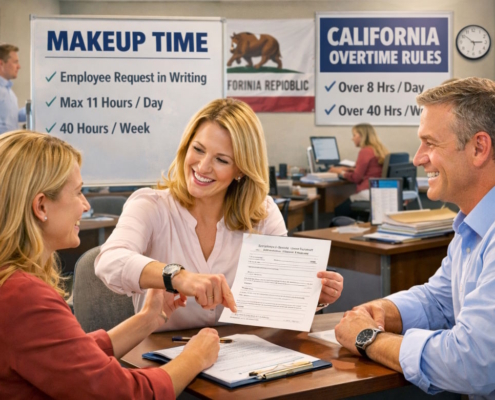
Makeup time has limits. An employee can’t stretch a day endlessly to “catch up.” No single workday can go past 11 hours, even when making up hours. The total for the week still has to stay at 40 hours or less.
Requirement #2
The timing matters. Missed hours have to be made up in the same workweek. Not next week. Not later in the month. If the week closes, the window closes with it.
Requirement #3
The request has to come from the employee—and it has to be in writing. Every time. A signed request is required for each instance of makeup time. It’s smart to back it up with a clear policy and a paper trail that shows the details. Who asked, when, and for how much time?
Requirement #4
Here’s the line employers can’t cross: you can explain that make-up time exists, but you can’t push employees to use it. No nudging. No hinting. The choice has to be theirs, start to finish.
Keep this straight, because California overtime stacks up fast. Time-and-a-half kicks in if an employee works over eight hours in one day. It also applies once they cross 40 hours in the same workweek. The first eight hours on that seventh day are overtime too if someone works seven days in a row.
Double time is a different line altogether. That applies after 12 hours in one day. It also applies once an employee goes past eight hours on that seventh consecutive day of work. Miss one of these thresholds, and payroll gets expensive very quickly.
Is makeup time an option under an alternative workweek?
Short answer: yes, sometimes.
California law does leave that door open.
Labor Code Section 513 lays it out in plain terms. If an employee has a personal obligation and asks in writing to make up the time they’ll miss, the employer can approve it. The key part? That makeup work has to happen within the same workweek.
Those extra hours aren’t counted toward daily overtime calculations. The added time is treated as a replacement, not an extension of the workday.
This isn’t automatic. It only works when the request comes from the employee, it’s documented, and it stays inside the same week. Miss any of those pieces, and overtime rules snap right back into place.
So yes, makeup time can still apply, even on an alternative workweek schedule. Just narrowly. And only when the rules are followed carefully.
Overtime Pay
It’s worth slowing down here, because there are limits. Makeup time doesn’t erase overtime entirely. If an employee works more than 11 hours in a single day or goes past 40 hours in the same workweek, overtime still applies. No exceptions there.
That daily 11-hour cap is especially important for alternative workweeks. In healthcare, for example, where 12-hour shifts are common, makeup time usually won’t work at all. You simply can’t tack extra hours onto an already long day without triggering overtime.
So yes, the law doesn’t ban makeup time for employees on an alternative workweek. But in practice, the room to use it is much smaller.
Take a four-day, 10-hour schedule. If an employee misses five hours on one of those days, they can’t just “spread it out” freely. At most, they could add one extra hour to each of the next three workdays before hitting overtime. After that, the flexibility runs out. In short: allowed, but tight.
Wage Order Flexibility
There’s actually a bit more breathing room built into the Wage Orders themselves. Section (B) (1) of the Industrial Welfare Commission orders that cover alternative workweeks allow something different from classic “makeup time.”
Here’s the idea: if an employee asks for it, an employer can occasionally swap one full workday for another full workday of the same length, without triggering overtime. It’s meant to handle real-life needs, not to reengineer payroll.
So, take someone on a four-day, 10-hour alternative workweek. If they miss one scheduled day, they can request to work a different 10-hour day outside the normal schedule. If the employer agrees, that substitute day doesn’t create an overtime obligation. Same hours. Different day. No penalty.
There are limits, though. Labor Code Section 513 makes one thing clear: employers cannot push or pressure employees to ask for makeup time just to dodge overtime. Employees have to initiate the request.
And just as important, nothing in the law forces an employer to allow makeup time or substitute days at all. These options exist, but they’re optional, not automatic.
Conclusion
Makeup time isn’t a cure-all system. It’s a narrow tool built for specific moments when work and real life collide. Used carefully, it can solve small scheduling problems without creating bigger payroll ones. Used casually, it can land an employer squarely in overtime trouble.
The key thread running through all of this is intention and documentation. The request has to come from the employee. It has to be in writing. And it has to stay within the tight boundaries California law sets. Once those lines are crossed—extra hours, wrong timing, or employer pressure—the flexibility disappears.
For employers, makeup time works best as an exception, not a system. For employees, it offers relief without burning leave. But both sides need to understand where it starts and where it stops.
Scheduling flexibility exists in California, but only in clearly marked spaces. Respect those limits. Make-up time can do exactly what it’s meant to do: help without hurting.