Introduction
Insufficient upkeep, improper design, or inadequate warning systems are responsible for numerous traffic accidents in California, unfortunately. If a county, city, or other public entity is responsible for the conditions of the roadway that helped cause the accident, the person involved may be able to seek a hearing. There are distinct legal rules, notification rules, and defenses. There is a difference between suing a municipality and suing a private citizen. You need an appropriate legal team to guide you through the process of suing a city.
If you think that a government agency’s poor road maintenance caused your accident, we will take you through all you need to know, including the legal foundation, what to establish, time frames, defenses, and future steps.
Legal Basis: Hazardous Condition and Arguments When Litigating Against a City
It’s important to understand whether you can sue a city for bad roads. According to Government Code 830–835, the legal precept that permits suing a government agency for road condition accidents is typically phrased as a “hazardous state of public property” assertion.
Some key statutory provisions:
- Gov. Code 830 outlines what makes an area or road a “dangerous state” of common property. It must be greater than insignificant; when applied in a fairly predictable way, there has to be a significant danger of harm.
- According to Gov. Code 835, in order for a government organization to be held accountable, the road has to have been hazardous at the time of the accident, the unsafe condition must have contributed significantly to the harm, and either the public agency or the city caused the condition (because of its workers) or had constructive or actual notice and failed to fix it within a reasonable time.
Additionally, before filing a lawsuit according to the California Government Claims Act, you must submit a “government claim” to the public organization within the allotted time frame (typically six months for wrongful death or personal damage).
What You Need to Show (Liability Elements) When Bringing a City Lawsuit
In California, you often need to demonstrate the following to successfully bring a lawsuit against a city or municipality for hazardous road conditions:
1. Control or Ownership
The property or road where the accident occurred must be owned or controlled by the public entity. The city might not be held accountable under these laws if it does not own or manage it. When prosecuting a city for a road accident, this is essential.
2. There was a dangerous situation at the time of the injury
The condition had to be present when the accident happened. It needs to be more than insignificant or unimportant. A hole, a fractured road surface, or missing signage are a few examples. It must present a significant risk. Whether you can sue a city for bad roads depends on many factors.
3. Reasonably Foreseeable Usage and Foreseeability
The public body should have reasonably anticipated that the situation might cause injury to those utilizing the route in a typical or expected manner. This relates to awareness.
4. Constructive or actual notice, or the entity’s creation
- Creation: Even in the absence of prior notice, responsibility may result if a public entity worker created the hazardous condition carelessly.
- Notice: In the event that the entity didn’t develop it, plaintiffs must demonstrate that the institution had either constructive notice (they ought to have known, given sufficient time or visibility) or actual notice (they learned about it) and could have fixed it but did not.
5. Substantial Factor and Causation
The hazardous situation had to have played a significant role in the collision and injuries, while it wasn’t the only one. Liability is not precluded by other variables (weather, driver conduct), but it must be demonstrated that the hazardous state was a significant contributing factor.
6. Damage or Injury
It goes without saying that there must be real harm, such as injuries to one or more people, medical expenses, lost income, or even car damage. There can be no claim or basis for challenging a city without damages.
Related Read: Average Car Accident Settlement for Back and Neck Injury in California
Requirements for Claims and Deadlines
Procedural constraints are one of the main obstacles to filing such cases in California:
1. Filing a Government Claim
Within 6 months of the occurrence, you are required by the Government Claims Act to submit a formal claim to the relevant government entity (city, county, or state). You may not be able to successfully sue a city for a claim related to an accident if you skip this deadline.
2. Waiting Time
The entity may reply within 45 days after filing. You have 6 months from the day of refusal to initiate a lawsuit against a city if they refuse your claim, which frequently occurs.
3. Limitations on Non-Governmental Claims
Timelines differ if you were taking legal action against a private party or in any other situation not related to government claims. However, the six-month claim period is required in actions against governmental institutions.
Road Conditions That Commonly Lead to Liability
The following are some common situations in which you might be litigating a city, and these claims come up:
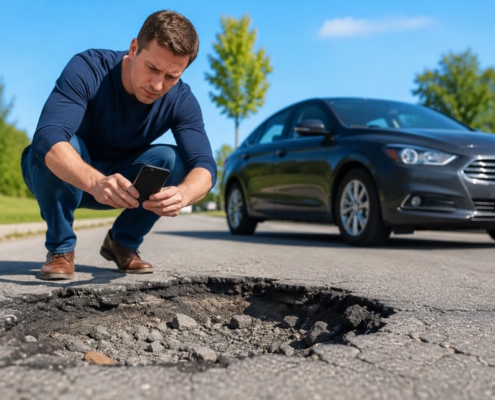
- Potholes, fissures, or missing pavement pieces.
- Sunken or uneven gutters or sidewalks.
- Guardrails or road barriers that are absent or broken.
- Inadequate or absent warning signs. No signage about potential dangers (dips, sudden curves, merging vehicles).
- Drainage issues that cause flooding & water accumulation.
- Items or debris left on the road.
- Trees and overgrown vegetation can obstruct sight lines. Majorly at crossroads and curves.
Immunities & Defenses
Public organizations have legal protections, even if the circumstances are in your favor:
1. Design Immunity (Section 830.6 of the Government Code)
In some situations, the organization may be exempt from liability if the hazardous condition was included in the original road or plan design and that plan was accepted by the appropriate public authority.
2. Immunity from Discretionary Function
Discretionary (not governmental) planning, policy, or design decisions may be protected. For instance, if a choice concerning a design standard was made voluntarily and in accordance with the procedure, it might not be contested.
3. Notice Deficiency
Liability usually fails if you are unable to demonstrate that the public body had constructive or actual notice. The plaintiff must demonstrate that the problem was either known or had existed long enough for the entity to be aware of it. Whether you can sue a city for bad roads comes down to whether the municipality ignored a known safety hazard.
4. De minimis: Small Flaws
Not every flaw is acceptable. According to case law, courts may determine that a modest or insignificant condition is not dangerous. A tiny fracture or slight depression in the pavement is such an example.
What Should You Do If You’re Thinking About Filing a Lawsuit
Here are some tactical actions to take if you think poor road conditions caused your injuries:
1. Record Everything Immediately
- Take pictures and videos of the precise spot. This includes the guardrails, road condition, signage, illumination, & any obstacles.
- Take photos of the injuries. Also, take photos of the damage to your car.
- Time, date, weather, and traffic have to be noted.
2. Obtain Information from Witnesses
Other drivers, motorists, & pedestrians may have noticed the danger or the accident. Independent findings may back up your claim.
It’s likely that the witnesses won’t have enough time to show up for the investigating officer’s interview call. Witness reports might undoubtedly be very important in your claim procedure. Therefore, ask the witnesses to provide written accounts of what they observed at the scene of the accident. If several witnesses noticed how the collision happened because of the dangerous state of the road, that would be huge points in your favor. Request that the witness sign the statement and add the date.
3. Medical Care
No matter how minor your injury is, let the paramedic team know about it and work with them. Don’t argue with the paramedic crew and allow them to take you to the hospital if they insist on doing so. See a doctor for a thorough medical examination if you are not taken straight from the accident site to the emergency room. This is due to the possibility that your compensation claim will be used against you if you refuse, postpone, or refuse to comply with the paramedics. The lawsuit you filed may be damaged if the adjuster interprets it as a claim that your injuries are unrelated to an accident.
4. Acquire Records and Reports
- Reports from the police or CHP (which usually detail the state of the roads).
- Records of government upkeep, earlier reports, or grievances over that section of the road.
- Get planning documents, inspection records, or design plans. They indicate whether or not a hazard was identified.
5. Safeguard the Scene
The route may be altered by towns or agencies later on. They do it by replacing the signs or paving over the flaw. Photographs, maps, and measurements must be preserved. It must be done as soon as possible.
6. Submit the government claim timely
Don’t hold off. There is a stringent six-month notice clause. A competent lawyer should assist you in accurately and promptly preparing the claim.
7. Employ a Skilled California PI Lawyer
Consult a local attorney if you’re unsure whether you can sue a city for bad roads. Which government bodies to name, how to collect records, how to fight design immunity, & how to reasonably estimate losses (including prospective medical bills, pain & suffering, etc.) are all skills that a lawyer who routinely handles unsafe road condition lawsuits will possess.
Legal investigation
Examine litigation brought against the Highway Administration (federal) and the Department of Transportation by visiting the federal courts. In particular, look for instances of poor road conditions in the area where your collision happened.
Examine lawsuits about road design, building, and upkeep that have been filed against the local municipal administration or private construction firms by visiting the county clerk’s office. In particular, look for examples that are more directly connected to your incidents and observe the proof utilized by the plaintiff as well as the amount of authorized compensation.
Contact the department of the attorney general for the state and request a copy of the advisory report supplied to the state or local governmental authorities connected to road conditions and dangers.
Look into litigation against government agencies online, paying particular attention to court proceedings, lawsuits pertaining to traffic accidents, and claim notices sent to government agencies.
Keep in mind that the victim of an accident is fully entitled to speak with a qualified personal injury lawyer. The compensation claim, the submission of a claim, and the determination of the appropriate amount for damage compensation can all be handled by a personal injury lawyer. If necessary, they may also bring legal action against a governmental body.
Highlight of a Current California Case and Precedent
A current incident worth mentioning: Whitehead vs City of Oakland. A bicyclist was injured after striking a pothole during a planned ride. The California Supreme Court upheld towns’ statutory need to maintain roadways in a sufficiently secure state and permitted the action to proceed despite the organizers’ plea for a waiver. Under state law, waivers cannot absolve them of that obligation.
Two important points are highlighted by this case:
- When there is a legal obligation to maintain public roadways, public organizations cannot escape accountability through broad waivers.
- Courts are paying more attention to making sure that procedural or contractual arguments aren’t used to avoid liability.
Recoverable Damages
In the event that your road condition case is successful, you might be entitled to:
- Medical expenses (past & future)
- Wage loss or diminished earning potential
- Emotional anguish, pain, and suffering
- Property damage or vehicle damage
- If there is egregious carelessness, there may be punitive damages, although this is uncommon.
Hiring an Attorney
If Med pay and PIP recovery are sufficient to cover your losses and injuries, it is not advisable to consult an attorney and submit a claim with the government agency. If you continue to pursue the government agency, it will be an unnecessary expenditure of time and money to hire an attorney.
You can depend on health insurance if the motor insurance company’s coverage is insufficient to cover your losses and injuries. Deductibles will then need to be taken care of.
Severe injuries require many complex claims. Traumatic Brain Damage, spinal cord injury, or fractured bones are a few examples. If you are seriously hurt, you can hire a lawyer to pursue possible compensation on your behalf. It shall be the lawyer’s obligation to find all monetary sources to acquire the highest sum.
A skilled personal injury lawyer can prove a few assertions.
- Despite bad road conditions, the other driver was partly to blame for the collision.
- The third party produced the road hazard. It resulted in an accident
- The government organization’s careless actions led to the mishap
If there are several reasons why the accident occurred, the lawyer will handle all of the possibilities of compensation.
Therefore, if you are hurt in a car accident because of bad road conditions, don’t wait. Hire a qualified personal injury lawyer and submit the compensation case before the deadline.