Introduction
The differences between a divorce, dissolution of marriage, and summary dissolution in California are confusing to many people. There is no doubt that they all signify the dissolution of a marriage. In California, divorce is synonymous with dissolution of marriage; in fact, the phrases are frequently used interchangeably.
This is due to the fact that California operates as a no-fault state. It means that there are just two legitimate reasons to end a marriage: insoluble differences & irreversible insanity. In contrast to a divorce and dissolution of marriage, summary dissolution offers a simpler method of terminating a marriage.
What Does California Marriage Dissolution Mean?
As was already established, from California’s perspective, trying to end a marriage is basically the same as getting a standard divorce. But this isn’t the same as an official separation.
Legal separation is the choice for couples who don’t wish to end their marriage but do want the court to make decisions on matters such as child custody. This is a common scenario when partners cannot divorce for religious reasons.
How Does Summary Dissolution Work?
The challenges that come with contemplating a divorce might make the choice much more difficult. One must consider whether there is a simpler method to go through the lengthy and taxing procedure of divorce. There is an easier way, which is wonderful news for some couples.
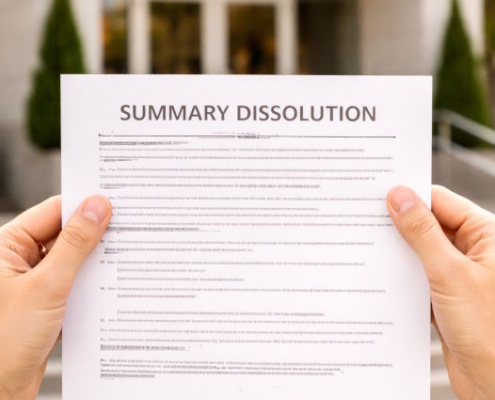
One method of getting a divorce without having to go in front of a court is through a summary dissolution. A couple may be eligible for a summary dissolution of marriage if both spouses agree to have a divorce and they fulfill certain prerequisites.
In California, the least expensive divorce procedure is a summary dissolution. Only one filing cost is required, and there is less paperwork.
But there are extremely precise standards that the couple must fulfill.
Furthermore, a divorce cannot be accelerated via summary dissolution because California has a waiting period of six months before ending any marriage.
When a summary dissolution offers a simpler option, why doesn’t everyone take it? Because it’s necessary for your divorce to be eligible for a summary dissolution, certain conditions must be fulfilled according to California Family Code Section 2400.
Conditions That Must Be Met in California for a Summary Dissolution
Fully understanding “What is a Summary Dissolution?” is essential before filing. According to California law, a couple must fulfill several conditions to obtain a summary dissolution.
- The cause of the breakup
- Conditions of residency
- The duration of the marriage
- Offspring of the union
- Separate and marital property
- Division of property
- Support from the spouse
- Revocation of the right to appeal
- And more
What is a Summary Dissolution? It is a streamlined divorce process designed for couples. They must meet strict eligibility requirements.
The following conditions must be met for a couple to obtain a summary dissolution in California:
- Both parties have consented to a summary divorce of their marriage or relationship because of irreconcilable differences.
- The divorce must be filed in a county where one spouse has lived for at least three months and for at least six months in CA.
- Together, you are childless, and you do not have adopted children younger than 18. Additionally, the wife might not have been pregnant when the filing was made.
- Your marriage survived less than five years.
- No real estate, including buildings or land, is owned by either spouse. A lease may be in place, but it cannot include a buyout clause. Within a year of the summary dissolution application being filed, the lease must terminate.
- Since the start of your union, neither partner has accrued debt exceeding seven thousand dollars. Auto payments do not apply.
- The amount of community property, which includes assets and obligations earned or acquired during the marriage, is $57,000 or less. Automobiles are exempt from this requirement, but any deferred remuneration must be included.
- No spouse owns over $57,000 in distinct property, which includes both pre-marriage and post-marriage assets.
- When neither spouse can agree on how to share assets and obligations, they could agree to a property settlement contract that divides their communal property.
- Spousal support rights must be relinquished.
- Once the legal system enters a summary dissolution, you have to give up your right to appeal.
- The California Courts give a document called Summary Dissolution Information, which you both swear to have read and comprehended.
What is a Summary Dissolution? As highlighted in this article, it is a simplified divorce procedure that allows couples to terminate their marriage without extensive court involvement.
Both parties must still agree to pursue a summary dissolution even if all the conditions are satisfied. The cancellation of the summary dissolution application may be filed by either party at any point during the procedure if they decide they no longer want to proceed with summary divorce.
The couple will then have to go through the normal divorce procedure. For the purpose of seeking a summary dissolution, both sides must also sign a document outlining the community’s asset distribution and liability assumption.
That is to say, each party should be able to divide its own property and responsibilities in a way that is acceptable for both of them. Both parties will be required to provide financial information as well as disclose all assets and liabilities. It is possible to submit a request for summary dissolution if each of these conditions is satisfied.