Introduction
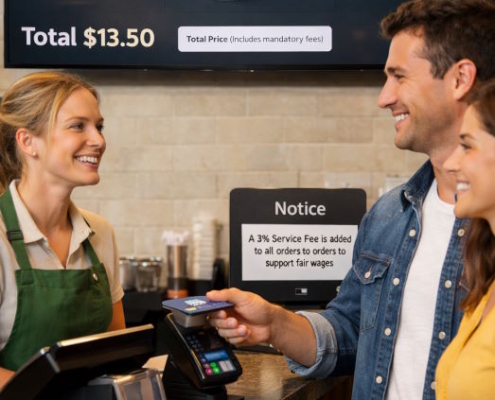
Restaurant surcharges remain the bright spot that enables restaurant operators to offer fair prices for food and services despite the industry’s changes due to inflation and price increases.
Tips, corkage, credit card payments, health insurance, and even a glass of drinkable water are included in these fees.
This may prompt a few customers to start shaking their heads in despair.
But as entrepreneurs, this may be among the most sensible strategies to preserve your company and continue to make money in the face of inflation.
15% of restaurant operators have incorporated restaurant surcharges into their invoicing practices, according to data collected by the National Restaurant Association (NRA).
Is this really essential, though? Should you also impose restaurant surcharges at your restaurants?
You may need to reconsider if you believe that by cramming in these charges or levies, you would alienate your diners and ultimately get the short end of the stick.
Restaurant Surcharge: What’s it?
A surcharge is an additional fee or charge that is added to the price of a good or service. Depending on the situation and the sector in which it is used, this financial add-on might take many different shapes.
For example, in the restaurant business, restaurant surcharges are frequently clearly shown on each customer’s invoice as corkage fees, employee healthcare costs, service charges, and government-mandated taxes.
For a while now, this phrase has been very popular in the restaurant industry.
The rationale is that this represents one of the finest strategies for recession-proofing your restaurant business, according to industry experts.
Getting around the restaurant surcharge law
You should thoroughly investigate the legal issues before introducing surcharges at your restaurant.
This laborious task will undoubtedly prevent your company from failing.
Local restaurant surcharge rules, especially those related to pricing openness and customer disclosure, must be followed by restaurant operators.
For instance, there are certain regulations dealing with restaurant fees in California.
In California, any fees or surcharges applied to restaurant invoices must be made explicit to patrons. Penalties & legal issues may arise from breaking these rules.
It’s critical to keep up with local regulatory requirements when applying a restaurant’s surcharges.
Six types of restaurant surcharges
As mentioned, these additional fees might take many different forms. The following are some typical restaurant surcharges:
1. A fee for services
When a consumer dines out, a service fee is a typical surcharge that is added to their bill.
It is intended to pay the employees of the restaurant for their services. Some restaurants use a service charge in place of individual tipping, which is subsequently divided among the staff.
This kind of fee streamlines the procedure and guarantees that your employees are fairly compensated for their labor.
2. Tip or gratuity
In many nations, it is usual for consumers to add extra money to their bill as a way of expressing gratitude for the service they received.
Tipping is typically at your clients’ discretion and might fluctuate, unlike a service charge.
Consider countries in Europe, for instance. In most European nations, leaving a tip of five to 10 percent is the general rule of thumb.
But in the US, this isn’t the case. In addition to other payments for additional or superior services, gratuities often vary from 15% to 20%, according to industry standards.
By charging these fees, customers can personally thank the service team and show their satisfaction.
3. Corkage costs
A corkage fee can be useful for wine lovers who would rather bring bottles of their own to a meal.
This fee pays for the opening & serving of the alcohol—or, in other dining establishments, a variety of other drinks—that your patrons bring into your business.
Since customers are not buying wine from the menu, the goal is to keep your restaurant profitable. Naturally, corkage costs differ from restaurant to restaurant.
Therefore, it’s a good idea to benchmark against the current fees of other establishments if you intend to incorporate this into your billing procedures.
4. A living wage or healthcare surcharge
In an effort to help their staff, numerous restaurants have implemented fees in recent years, particularly after the start of the epidemic.
The medical insurance or living wage fee at restaurants is an extra charge on your patrons’ bill that goes toward offering perks, including staff wellness, electronic EMR software, healthcare, and fair wages.
This strategy guarantees that your restaurant employees receive fair compensation and attention, which eventually raises employee morale and improves service quality.
5. Environmental fee
Restaurants have adopted sustainability measures. An environmental tax is implemented in reaction to growing environmental awareness.
Environmentally friendly practices include buying products that are green, avoiding food waste, and installing energy-saving infrastructure. They are funded by this surcharge.
73% of consumers worldwide are prepared to pay extra for sustainable goods and services (Nielsen study). It demonstrates the growing significance of environmentally responsible behaviors.
This enables you to move toward a more environmentally friendly option. It informs your clients of your dedication to environmental responsibility.
6. Taxes & fees imposed by the government
Government charges and taxes increase your customers’ expenses even if they are not directly within your restaurant’s control.
Value-added tax (VAT), Sales tax, and other state and local taxes are examples of these non-negotiable fees.
These taxes are necessary to adhere to local tax laws, and you are responsible for collecting and sending them on behalf of the authorities.
You can accomplish this, for example, by imposing surcharges or adding rates of tax to menu pricing.
What Benefits Come with Including Restaurant Surcharges?
1. Keeping up with growing expenses
Restaurant operators struggle to stay profitable in today’s world. Labor, food, and other operating costs keep going up. These rising expenses may be partially countered by surcharges.
2. Ensuring equitable compensation & benefits
Many eateries want to give their staff members higher pay & perks. These initiatives can be supported by levies, such as healthcare and employee wellness fees.
According to statistics from a restaurant employment survey, workers are more likely to stick around if their employers let them leave tips, pay them appropriately for their hourly work, and provide them with enough benefits.
You can provide your staff with all of these advantages through surcharges.
3. Sustainability
Restaurant surcharges are assisting in funding sustainability projects.
4. Price transparency
Unexpected bills are not liked by anyone. Surcharges included in restaurant receipts provide a crucial benefit of clear pricing.
What is the appropriate amount of a surcharge? Four points to think about
Choosing the right surcharge amount is important. There is no one-size-fits-all solution because it relies on the objectives of your business and the surcharge’s intended use.
The choice may be influenced by a number of factors:
1. Local laws
The maximum permitted surcharge percentage is mostly determined by local laws. The application of surcharge percentages by restaurant operators is subject to stringent regulations in some states or areas.
Some restaurant operators in Washington now charge their patrons a service fee of twenty percent. This was mentioned in a WUSA9 report (September 2023).
California passed Senate Bill 478. The law focuses on what are referred to as “junk fees”. They are unanticipated or concealed costs imposed by companies. It is common in the lodging, travel, and event sectors.
Kathy Hochul (New York Governor) enacted the credit card fee law. It mandates that companies, including eateries, modify their payment procedures. It is to guarantee that any credit card fees are completely visible & compliant with the law.
This implies that, based on the current restaurant surcharge legislation in each state, the surcharge amount may likewise vary greatly.
2. Analysis of costs
It is an essential stage in determining a surcharge.
You must evaluate your particular costs as a proprietor of a restaurant. Things like the price of ingredients, employee salaries, utilities, & rent. The goal is to find the difference between the expenses & earnings of the restaurant.
You might explore menu engineering techniques or strategies to further increase the financial viability of your menu items.
This tactic will assist you in creating attractive menus that won’t reduce your chances of making the most money possible.
3. Analysis of competitors
Examining what other local eateries are doing will help you decide how high your surcharge should be.
It offers insights into what consumers would find acceptable. It isn’t a precise guideline, though.
34% of customers take cost competition into account when selecting a restaurant (National Restaurant Association poll)
This data highlights how crucial it is to maintain competitiveness when determining surcharge amounts.
4. Feedback from clients
Your consumers’ opinions are important.
Gathering and evaluating a survey about the cuisine, services, and overall operations of your restaurant will assist you in determining their responses, particularly with regard to charging.
Maintaining client happiness is important since satisfied customers have a tendency to come back. Additionally, it helps determine whether the surcharge meets their expectations.
How to incorporate automated restaurant software with fees
The software for QR code menus is one of the cutting-edge solutions revolutionizing the eating experience. Restaurants can easily implement and oversee restaurant surcharges using interactive restaurant software.
This is how:
1. Using dynamic restaurant menu software for taxation
You can automatically include the taxes that apply to dine-in or takeout orders by turning on the taxation option.
Your consumers will see their entire bill, including VAT, sales, delivery, and other taxes, after placing an order using your digital menu QR code.
Every bill will include this, making it easier for you to monitor every order and payment.
You are encouraging transparency when you automate or add taxes to menu pricing directly on the program, which improves your reputation and dependability. Strong interactions with clients will follow from this.
2. Tipping via a menu with a QR code
Tipping features are superior to asking for tips across the register, on bills printed on paper, or on automated point-of-sale invoices.
Streamlining payments, providing insightful information, and increasing revenue make restaurant owners’ lives easier.
Additionally, it represents positive news for clients.
Customers can choose their tip without feeling rushed or under pressure. You can express that you are in control of the dining experiences.
Understanding how to integrate restaurant surcharges with digital applications becomes essential in the constantly changing restaurant industry.
It makes sense to have measures in place to maintain your business. The growing demand and difficulties of running a restaurant can be immense.
The dining experience is improved by learning how to use a menu QR code in a restaurant.
It’s critical to comprehend the legal ramifications and maintain openness while imposing restaurant surcharges.
Additionally, communication is vital in preventing misunderstandings when it involves tipping.
Conclusion
Running a restaurant today isn’t simple. Costs rise, expectations rise, & margins shrink.
Surcharges help you survive that pressure. They keep the lights on. They keep your staff paid, and they keep the business steady when everything else feels shaky.
But it is not just about adding fees. It’s all about being honest, clear, & transparent. It’s important to tell people the cost breakdown. Most customers understand when you treat them like adults. In the end, surcharges aren’t a trick. They’re a tool. Used well, they protect your restaurant and your team. They enhance the experience you’re trying to deliver every single day.