Introduction
Before starting operations, almost every company operating in the United States must get an Employer Identification Number (EIN) from the IRS. Knowing whether a company has an EIN is important for determining whether it is lawful to accept it as a partner or client. That’s just half of the fight, though.
For example, how do you ensure a company doesn’t get a new EIN after it has changed its ownership structure? You have to be certain that the company is not using the EIN of another company. To validate an EIN number, these concerns must all be addressed by cross-referencing various data sources.
Fortunately, there are tools that combine information from several sources to automate and simplify the process of confirming an EIN, as this post will show.
Let’s start by taking a step back and going into greater detail about what an EIN number is and why businesses in business-to-business interactions need to confirm their respective EIN numbers.
An EIN number: What is it?
All United States firms are assigned a unique nine-digit number. It is called an Employer Identification Number (EIN) by the IRS. For the purpose of monitoring tax reporting, it makes it simple for the IRS to recognize a company. An EIN is required for all U.S. businesses to operate lawfully.
EINs are commonly referred to as “Tax Identification Numbers,” or TINs. However, any identifying number that the IRS uses to monitor tax returns is referred to as a TIN. Thus, for individuals, an SSN (Social Security Number) is a TIN as well. An EIN, on the other hand, constitutes a TIN for corporate entities.
Why businesses must confirm their EINs
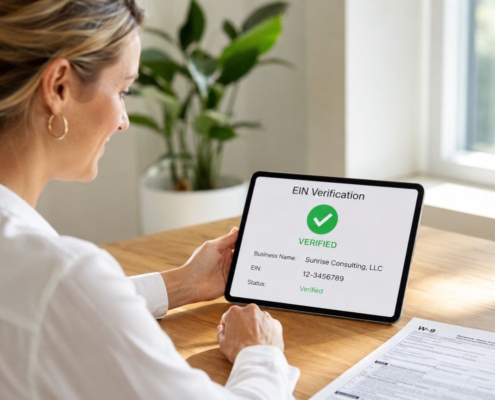
Companies that want to onboard another company as a client or partner must adhere to stringent KYB (Know Your Business) regulations in many industries. This entails determining the legitimacy of the company and its owners as well as assessing the possible dangers of doing business with them. Fake or counterfeit EINs are frequently used by scammers to obtain money and vanish. The company’s legitimacy and ongoing registration are confirmed by a brief check. It’s important to understand how to verify an EIN correctly.
To operate lawfully in the United States and to carry out certain other financial & insurance-related tasks, a firm needs a current EIN. Thus, EIN verification is a minor but essential phase in a company’s process of confirming the legitimacy of a company it wants to cooperate with.
When you file tax forms, the IRS cross-checks your EINs; discrepancies result in backup withholding and penalty warnings. This lesson is painfully learned when a supplier’s EIN is discovered to be invalid following a year of payments.
This involves making sure the EIN is legitimate and connected to the company in question as a component of your KYB procedure. In order to safeguard itself against legal liability & other dangers, the corporation will want to reconsider its partnership with the business if it isn’t.
How is EIN verification carried out via EIN search tools?
EIN verification search tools can obtain information from a number of sources. Government websites, like state Secretary of State websites, the SEC’s EDGAR database (for businesses listed on the stock exchanges), and the IRS itself (charities and nonprofits), are the most reliable sources.
EIN verification tools will look for numbers in a specific format along with the company name because EIN numbers always consist of 9-digit numbers in the form “XX-XXXXXXX.” Additionally, automated systems can verify the validity of an EIN number by looking up its first two digits using the IRS’s list of acceptable EIN prefixes.
How to confirm a company’s EIN number
You can locate or cross-reference a company’s EIN in a few different locations. Some are more accessible (and less costly) than others. Take note of the dates on records and the most recent update date on websites. Make sure you locate the most recent EIN because there are situations in which a company may alter it. This section outlines how to verify an EIN using commonly available resources.
1. Assess the EDGAR system of the SEC
Examining the Securities and Exchange Commission’s Electronic Data Gathering, Analysis, & Retrieval (EDGAR) tool should be one of the initial stages in confirming an EIN. A company must register and submit reports to the SEC if it offers its stocks for sale on an open stock market; this information is available in EDGAR. Knowing how to verify an EIN can save time.
Enter a company’s name, stock symbol, or Central Index Key (CIK) number (used to uniquely recognize companies that have filed records with the SEC’s database) into the SEC’s EDGAR Text Search. You may also look for a particular person linked with a firm (or the CIK number), or a term in a document. Additional search functions allow you to narrow down by filing type, date of filing, and what state or nation a business’s location is in. Then hit Search.
A company’s quarterly filings or yearly reports are the simplest places to locate its EIN. The choices on the left portion of the results page allow you to filter for various kinds of files. Next, choose the file you want to see.
The company’s EIN number should be located close to the upper part of the page. On these kinds of reports, it will be identified as “IRS Employer Identification Number.”
2. Look through the Secretary of State’s business directory for a state
If you are aware of which U.S. state the company is registered in, a Secretary of State Company database is another conventional method for verifying an EIN number. Conducting a Secretary of State Company search may require creating an account & paying a charge in certain states.
As an example, let’s look at Delaware. The state in which Google was incorporated. Navigate to Delaware Company Search. Select “Company Name” or “File Number.” Enter the registration number or name of the company, appropriately. Next, select “Search.”
The data file for the company—in this case, Google—is displayed. However, this summary does not include the EIN number. You can ask for a report that contains the business’s tax assessment data, which probably has the EIN. However, it costs $20 to complete the transaction. You must either create an account or log in.
3. Go straight to the IRS for nonprofit organizations
Going straight to the IRS and the Tax Exempt Organizations directory will allow you to confirm the EIN of the company you are studying if it is a charity or non-profit.
Choose “Organization Name” underneath “Search By” in the Tax Exempt Organization Search. Click the “Search Term” field. Enter the name of the company. Results can be filtered by nation, state, city, and database. Lastly, select “Search.”
Each match’s EIN number is displayed in the query results. Click on the organization’s name if you want more details.
The organization’s tax-related records that the IRS maintains on file are displayed here. A drop-down list will appear when you click on one. Additional specific details, including occasionally a link to the document itself, will be there.
You can download/print the document by clicking this link. The entity’s EIN ought to be printed somewhere on the document.
4. Ask an established credit bureau for a report
Getting a statement from a reputable credit rating service is another option to confirm an EIN. Leading credit bureaus can offer copies of company credit reports upon request since business credit rating data is less confidential than personal credit scores.
However, not every credit agency will offer the same choices. Some will let anyone create an account and purchase a report, such as Dun & Bradstreet.
Others, such as Equifax, will expect you to work for a corporation and get in touch with their sales team directly in order to get a report.
Since not every credit bureau will include a company’s EIN (or tax-associated data in general) in their reports, look for standard reports to check for this information and make sure to inquire about its availability before buying a report.
5. Talk to the company’s accounting division or look in other public areas
A company’s written articles or other papers (such as letters or invoices) or anywhere on their online presence (try the “Contact Us” or “About” page) may provide you with an EIN number.
If not, try to find the company’s contact information or email address. If you can’t get through to the payroll or accounting department directly, try to locate one that can.
Keep in mind that misusing an EIN is illegal under federal law, so some companies could be reluctant to provide their EIN or skeptical of your motivation. The request will seem more legitimate if it is sent from a corporate email address containing a corresponding signature line or, if at all possible, from a business phone number. Give a detailed explanation of your business’s requirement for the number, mentioning that it will only be utilized for KYB verification.
Sending a W-9 form to the company’s accounting department is an additional choice. This particular IRS form is used to ask for TINs or EINs in order to validate them for KYB or KYC purposes.
Because it necessitates delivering the company’s information and permits the recipient company to retain a copy, this is a safe alternative. Because it understands exactly who made the request, the company can be confident that its EIN will be used appropriately. In the case that the EIN is not being used correctly, it can submit the details to the authorities.
6. Make use of an automatic EIN search tool
Some companies are committed to gathering the data that companies require for KYB. They let you search companies by name and state, just as the SEC’s EDGAR information. Finding the matching business record, choosing it, and displaying the data are the next steps.
Tools for automating the process of EIN verification search
Bigger companies usually do not have the time to manually onboard and/or verify numerous business partners and clients in a short amount of time. Thankfully, there are a number of specialized services available that can automatically verify that EIN numbers (as well as other business data) are legitimate and correspond to the correct companies. Here are examples.
1. EIN Finder
Judy Diamond Associates’ EIN Finder has more than 14 million distinct records, including EINs and other business-related data. It can locate companies using their state, ZIP code, and/or registered and “doing business as” names. Additionally, the accuracy of each address and EIN is confirmed by comparing them with the IRS and USPS, respectively. Additionally, it makes it possible to perform a backward EIN search to confirm if an EIN is associated with a specific company.
It can be costly if you want to use it extensively. Additionally, it lacks a lot of additional company information that can be helpful for evaluating risk in KYB.
2. EIN Search
EIN Search, which is supplied by Liberty Data, has more than 18 million company files with IRS-verified EIN numbers. Additionally, it enables both automated checking via API and bulk matching lists of companies with their EINs. However, plans that include API access are somewhat costly, and its data is refreshed only on a quarterly basis.
3. Signzy
Signzy goes far beyond simple EIN matching; just one API call yields more than thirty data points, such as ownership information, sanctions assessment, and license status in each of the 50 states. Ongoing monitoring is what really sets it apart from the alternatives; instead of treating validation as a box you tick once during onboarding, it continuously monitors confirmed organizations and notifies you when something changes.
4. REALSearch
REALSearch is designed for teams that only require a quick, clear match outcome. It performs its function without needless complexity and interfaces with current transaction systems with ease. It works well for simple matching, but go elsewhere if you require monitoring or more detailed compliance data.
Conclusion
Through enhanced tax compliance and government verification, EIN is a dual-purpose tool that helps your company improve its reputation. Additionally, EINs assist your company in confirming the legitimacy of other businesses it may interact with. This makes it possible to avoid dubious or unlawful companies as well as other harmful actors. Businesses must understand how to verify an EIN before completing financial paperwork.