Can You Get a Job at 14 in California? Legal Requirements, Work Permits, and Hour Limits Explained

Teens aged 14 can work in California if they follow legal steps, including permits, hour limits, and school attendance. Employers may face fines for breaking child labor rules or ignoring legal requirements related to young worker employment.

By Brad Nakase, Attorney

Email  |  Call (888) 600-8654

Have a quick question? I answered nearly 1500 FAQs.

Introduction

Can you get a job at 14? In California, the answer is – yes, with conditions. Although anyone below the age of 18 needs a work permit, the minimum age to work in California tends to be 14 years old. The permits are called a Request for Work Permit and Statement of Intent to Employ Minor. Usually, a minor’s school issues these permits.

The minor fills out the statement & request, and both the employer and the child’s parent or legal guardian must sign it. The form is given back to the school, which then provides the permit after receiving the necessary signatures. A duplicate of the minor’s work permit must always be present at the workplace. These licenses need to be renewed each academic year until the worker reaches the age of 18.

Let us go into more detail to answer the common question: “Can you get a job at 14?”

Restricted Employment

If a juvenile works odd jobs around the house or babysits, no work permit is required; however, there are several jobs that are off-limits to anyone younger than sixteen. Some of those vocations, as defined under California law, include working as a driver, in tunnels, mines, on railroads, or boats.

How about school?

Can you get a job at 14 and still go to school? Absolutely. But school attendance is a must. Unless they have graduated, minors under the age of fifteen must go to school full-time. Those who are aged 16 or 17 years old, have a job, and have not completed high school must spend at least four hours a week in what is referred to as continuation school.

If the worker does not have a regular job, they must attend school for a minimum of 15 hours every week.

Can you get a job at 14 and work full-time? Only when school is not in session.

Under-16-year-olds are allowed to work 8 hours a day, or forty hours a week (when school/classes aren’t in session).

People over the age of 16 are allowed to work 8 hours a day, and a maximum of 48 hours in week.

Working Hours

Employees between the ages of 16 &17:

  • Permitted to work up to 48 hours a week,
  • Four hours on school days, and
  • Eight hours on days of no school or the days before non-school days.

Individuals between the ages of 14 & 15:

  • Permitted to work 3 hours a day on days of school, and
  • Up to 8 hours per day on non-school days,
  • Total of eighteen hours per week.

Children in the Entertainment Sector

California has legislation specifically targeting children employed in the entertainment business because it is one of the state’s largest employers. The Division of Labor Standards Enforcement must grant an Entertainment Work Permit to minors employed in the entertainment sector. For children who want to find employment in entertainment, this body has its own rules.

California child labor regulation penalties for companies that break the law

An employer may face Class A or Class B charges for breaking California’s child labor regulations. A Class A infraction can be fined between $5000 & $10000. Class B violations carry fines ranging from $500 to $1000. It may even lead to criminal charges.

“Can you get a job at 14 in California? Definitely. But only with the appropriate paperwork, time limits, and protections.


Have a quick question? We answered nearly 2000 FAQs.

See all blogs: Business | Corporate | Employment Law

Most recent blogs:

How do I know if I am exempt from overtime pay?

Check if you qualify for California overtime pay in 2026, including daily, weekly, and seventh-day rules. See exemption tests, salary thresholds, union contract exceptions, and steps to recover unpaid wages with penalties and filing deadlines.

Working Off the Clock: California Law

Working off the clock in California can trigger back pay, overtime, and penalties when employees work unpaid hours you knew about. Get examples, warning signs, and practical steps to prevent payroll issues, burnout, and costly wage claims.
Retaliation in the Workplace in California - What It Means and How It Works

Retaliation in the Workplace in California: What It Means and How It Works

Workplace retaliation in California can include firing, reduced hours, demotions, write-ups, or isolation after reporting harassment, discrimination, or safety issues. See what counts as retaliation, what doesn’t, and how to document patterns, preserve evidence, and build a timeline supporting a claim.
Is Automatic Gratuity Legal in California in 2025

Is Automatic Gratuity Legal in California in 2025?

Automatic gratuity remains legal in California in 2025, but restaurants must follow strict disclosure, payroll, and tax handling rules. This guide explains service charge requirements, IRS treatment, staff training, and practical compliance steps for restaurant owners.
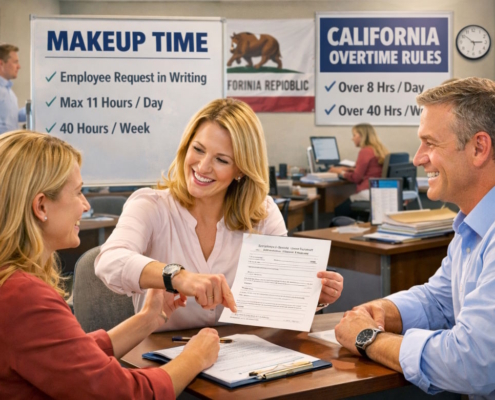
How Makeup Time Works in California and When It Can Be Used

How Makeup Time Works in California and When It Can Be Used

California makeup time lets employees shift weekly hours without overtime when requests are written and limits stay within Labor Code rules. This article explains eligibility, daily and weekly caps, alternative workweeks, and employer restrictions that affect payroll compliance.
Vacation Pay in California - Rules on Accrual, Caps, and Payouts

Vacation Pay in California: Rules on Accrual, Caps, and Payouts

Get a practical overview of California vacation pay rules, including accrual methods, lawful caps, and payout obligations for departing employees. Help your company avoid wage claims by setting compliant vacation policies, tracking balances accurately, and paying unused time on separation.
Personnel File Request California - Employee Rights and Employer Duties

Personnel File Request California: Employee Rights and Employer Duties

Get a practical overview of California personnel file requests, including employee rights, employer duties, record contents, and medical privacy rules. See how deadlines, penalties, and strict documentation practices affect compliance when workers request copies of their personnel records.
Employer vs Supervisor - Differences in Roles and Responsibilities

Employer vs Supervisor: Differences in Roles and Responsibilities

Compare employer and supervisor roles, from legal responsibility to daily management, so workers see who controls policies and everyday work. Get a simple breakdown of authority, decision making, and workplace impact to clarify who to approach when issues arise.
Target policies for employees - Recruitment, Pay, Culture

Target policies for employees: Recruitment, Pay, Culture

See how Target's HR policies shape recruitment, pay, and culture to attract and retain top retail talent. Review Target's focus on training, inclusion, benefits, compliance, and HR technology to support engaged, high-performing employees.

Contact our attorney.

Please tell us your story:

0 + 8 = ?